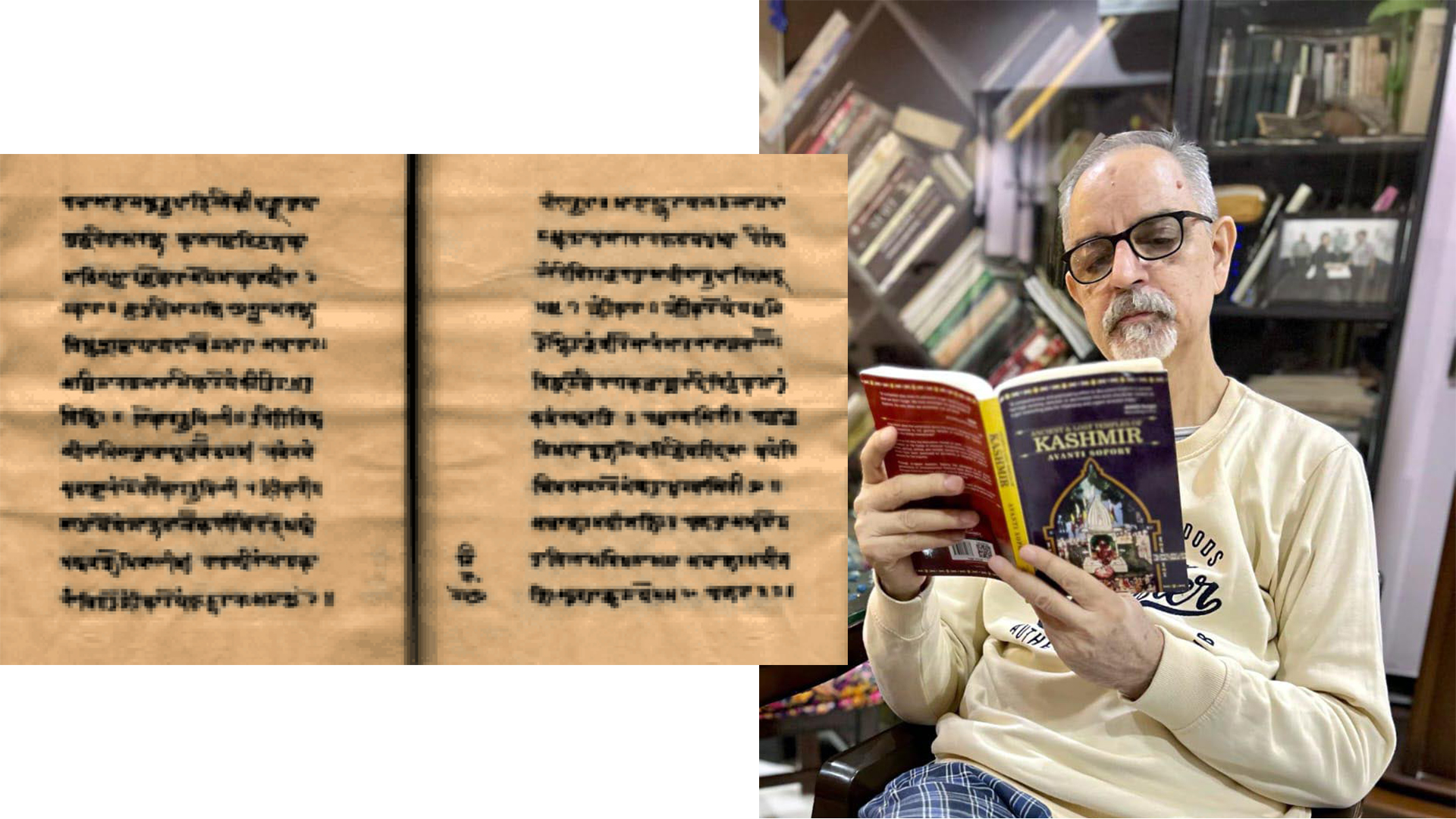
Originating in Kashmir and spreading widely across north-west India—including the Punjab hills and the old Gandhara region—Sharada is the supreme indigenous alphabet of ancient Kashmir. It flourished between the 8th–9th century and the 15th century, after which it was gradually replaced by the Persian script following the advent of Islam in Kashmir. Used exclusively to write Sanskrit and Kashmiri in earlier times, the use of the Sharada alphabet declined steadily from the 16th century onwards, and today it has become virtually defunct. In modern times, it has been largely ignored and forgotten; very little substantial work has been produced on it for over a century, despite the fact that many of Kashmir’s greatest Sanskrit works were originally written only in this script.
To stem this decline, a significant initiative was jointly undertaken by the National Book Trust of India, the Nityanand Shastri Kashmir Research Institute, the Paannyaar Kashmir Research Foundation, and Ansh Publications and Distributors. Together, they organised ‘Saradaksharani: The First National Exhibition on the Sharada Alphabet’ during Kashmir’s annual literary festival, the Chinar Book Festival, held at the picturesque Sher-i-Kashmir International Convention Centre on the banks of Dal Lake, Srinagar. The concept, content, and display were curated by a joint team of experts from the National Book Trust and the consortium institutions, including eminent Kashmiri scholars Shri Ramesh Manvati and Shri C. L. Kaul.

The ten-day Book Festival and Exhibition, held under the auspices of the Ministry of Education, Government of India, remained open to the public from August 2 to August 10, 2025. Owing to its national importance, the Exhibition was inaugurated by Union Education Minister Shri Dharmendra Pradhan and the Hon’ble Lieutenant Governor of the J&K UT, Shri Manoj Sinha.
The Exhibition attracted a large number of local visitors—men and women of all age groups, students from universities, colleges and schools, as well as scholars of Kashmiri language, literature, and archaeology. It showcased paleographic plates of inscriptions, rare manuscripts, religious texts, profiles of savants and scholars, and a detailed historical account of the Sharada alphabet through rare and previously unseen documents.
Among other dignitaries who visited were the Chairman of the Indian Council of Historical Research, Prof. Raghuvendra Tanwar; the Vice Chancellor of the University of Kashmir, Prof. Nilofar Khan; and the Chairman of the National Book Trust, Prof. Milind Sudhakar Marathe. They were taken through the Exhibition by the eminent Kashmiri scholar Dr. S. N. Pandita, the main curator.

During discussions between dignitaries and Dr. Pandita, it emerged that institutions such as the University of Kashmir and the J&K Academy of Art, Culture and Languages should take the initiative to promote this unique script. It was suggested that formal teaching courses be developed by experts so that students of all faiths can learn the alphabet.
While the University of Kashmir appears to have accepted this recommendation, its decision to run the Sharada promotion programme under the Department of Persian is, prima facie, deeply flawed.
The choice is troubling and ironic. It was precisely the introduction and imposition of the Persian language and script in Kashmir in the 15th century that replaced Sharada and gradually led to its disappearance.
Why the University did not consider the Department of Linguistics or the Department of Kashmiri Language for this programme remains inexplicable. It is also pertinent to point out that the University of Kashmir has a dedicated Department of Sanskrit, which would be the most natural and academically appropriate home for the revival and teaching of the Sharada script. Historically and structurally, Sharada is intimately linked to Sanskrit and was primarily evolved and used for recording Sanskrit texts in Kashmir for several centuries. Almost the entire classical Sanskrit corpus produced in Kashmir—spanning philosophy, poetics, grammar and ritual literature—was originally composed and preserved in the Sharada script. Entrusting its revival to the Sanskrit Department would therefore ensure doctrinal continuity, philological rigour and scholarly authenticity, something that cannot be achieved under a department historically aligned with an alien linguistic tradition.
It defies logic to entrust the revival of Sharada to the very linguistic tradition—Persian—that historically contributed to its decline.
It must be noted that the Sharada script is the original script recognised for writing Kashmiri, as reflected in the Eighth Schedule of the Constitution in the list of Indian languages. The later inclusion of the Persio-Arabic script is a distortion that undermines the constitutional status of Kashmiri. The official adoption of the Persio-Arabic script, therefore, deserves an immediate review to prevent further confusion and to counter divisive narratives. The perception among certain sections of society that Sharada revival is unnecessary or politically motivated is entirely misplaced.
The authorities are strongly urged to revisit the decision of entrusting the Sharada programme to the Department of Persian. Since the adoption of Persian was historically responsible for the decline of Sharada, the present decision is not only incongruous but also risks perpetuating a historical wrong. This misplaced move requires urgent correction.
Given these considerations, the revival and promotion of the Sharada script rightfully belongs with the Department of Linguistics or the Department of Kashmiri Language, where it can be handled with scholarly integrity and cultural sensitivity. A defeatist approach at this stage is wholly avoidable.

(The writer is a Jammu based environmentalist and a regular contributor to this Website.)
(Feedback at: blparimoo@gmail.com)
Grenade Exploded… and My Life Changed Forever — The Story of ‘Sajid Grenade” | ft Rama Deepak | Ep28

The First Olympian from J&K || Gul Mustafa Dev’s Inspiring Story || An Evening with Rama Deepak || Ep27